The comprehension cursor
Agents don’t start the decay: they simply stop the top-up.


No method nor discipline can supersede the necessity of being forever on the alert.
Henry David Thoreau, Walden.
As I argued in a previous essay, LLMs can erode judgement as we need more of it to fight the complexity LLMs introduce. To clarify our options, I will go back to one of the many things I learned from my former control-theory expert colleagues: “you must model something before you can control it”.
For the purpose of this essay, I propose this simplified model for software development:
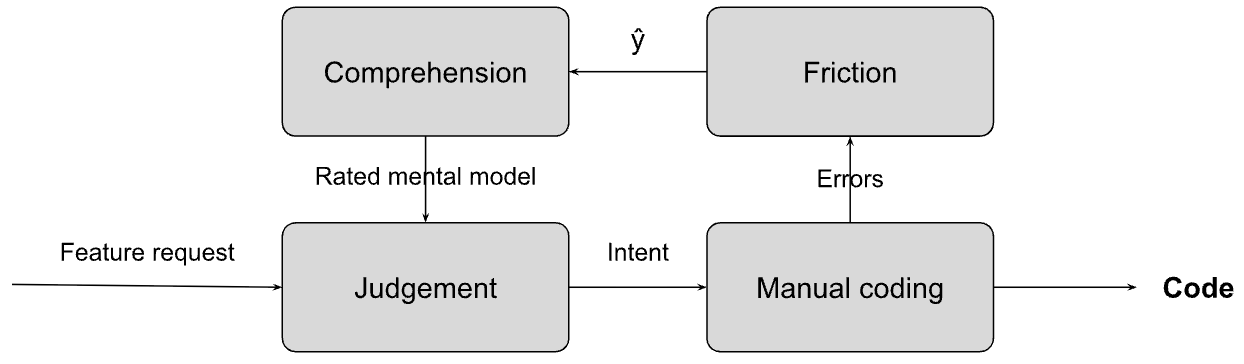
Peter Naur (yes, the same Peter Naur from the “Backus-Naur Form”) said “programming properly should be regarded as an activity by which the programmers form or achieve a certain kind of insight, a theory, of the matters at hand”. This is why the previous diagram says software development transforms feature requests into code using judgement. That judgement comes from our confidence-rated mental model, continuously adjusted as our view of the world ŷ surprises us.
Now what happens when we have access to a good agent?
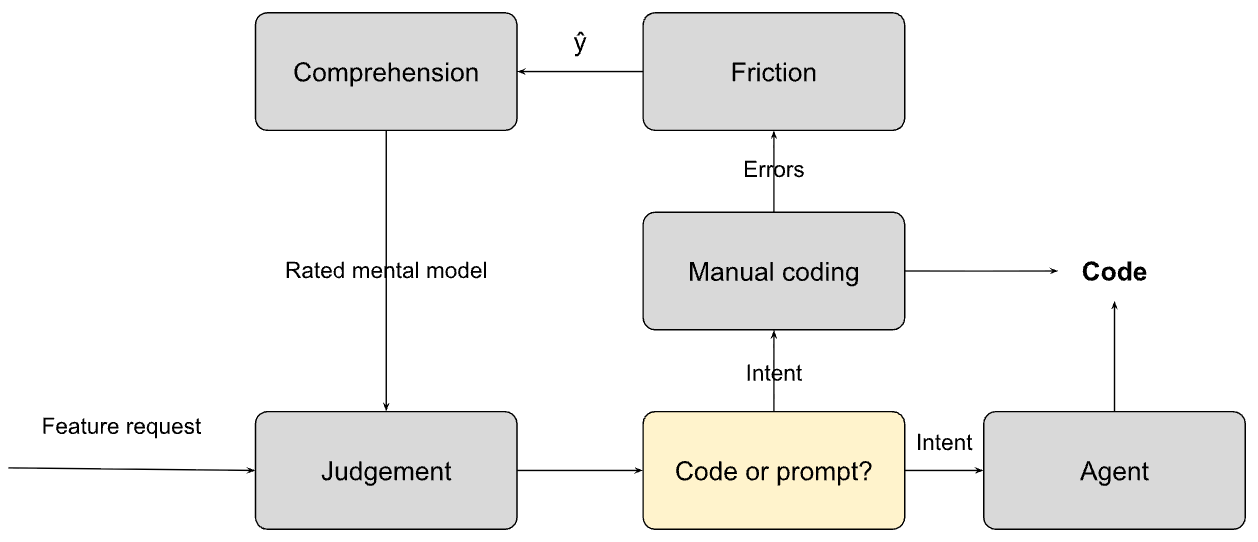
When we let the agent code, we no longer experience the friction and hence we no longer get the feeling of unease when we don’t understand the code, the sense that our model does not match reality, which can be used to recalibrate our model. This comes for free when coding manually. When relying on agents, we cannot feel our judgment slipping because the alarm that is supposed to warn us our comprehension is decaying is itself computed from comprehension. This is what Nataliya Kosmyna et al. called cognitive debt: “Cognitive debt defers mental effort in the short term but results in long-term costs, such as diminished critical inquiry, increased vulnerability to manipulation, decreased creativity“.
In addition, we can not only delegate the implementation but also never be in a situation where we don’t understand: we can now borrow comprehension from the agent the same way we borrow coding. This is the point Adler carries (from How to Read a Book): a live teacher can answer you, so with a book you must do the work of interrogation yourself — and that unaided struggle is where the understanding gets built. The LLM ends that condition permanently: there is now always a present teacher, so you are never again alone with the book. But an explanation received is not understanding.
Comprehension was always a leaky reservoir: even without agents, knowledge that has not been used in a while gets garbage-collected. Manual coding is a continuous top-up of that reservoir, like a spaced repetition mechanism, refreshing the knowledge that is used the most. The agents don’t start the decay: they simply stop the top-up. We now get to set a cursor on whether to pay for comprehension, or borrow and move faster. How to do this is the subject of the next essay.